

Allscripts — now operating under the Veradigm brand for its data analytics division — has been a significant player in healthcare IT for over two decades. With its Sunrise and Paragon platforms serving hospitals worldwide, Allscripts offers enterprise-grade clinical systems. This comparison helps hospital administrators decide between Allscripts and HospitalOS for their facility's needs in 2026.
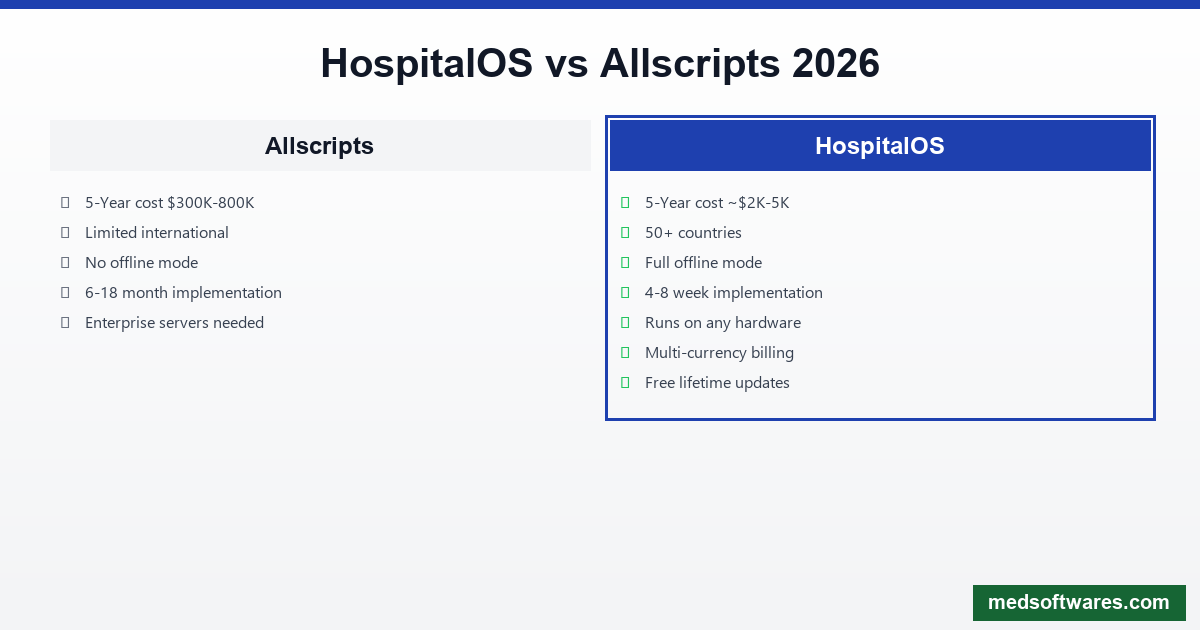
Quick Comparison
| Factor | HospitalOS | Allscripts | |--------|------------|------------| | Pricing Model | One-Time License | Annual Subscription | | 5-Year Cost (100-bed) | ~$2,000-5,000 | ~$300,000-800,000 | | Offline Mode | Full | No | | International | Yes (50+ countries) | Limited | | Target Market | Small-to-mid hospitals | Mid-to-large hospitals | | Implementation | 4-8 weeks | 6-18 months | | Key Platform | HospitalOS | Sunrise / Paragon | | Open APIs | Basic | Yes |
Pricing Comparison
HospitalOS Pricing
- Model: One-time license fee
- Starting Price: Based on facility size
- Multi-Facility: Discounted per additional site
- Updates: Free lifetime updates
- Support: Included
- Infrastructure: Standard hardware
5-Year Total Cost (100-bed hospital): ~$2,000-5,000
Allscripts Pricing
- Model: Annual licensing + implementation fees
- Implementation: $200,000-800,000+ (varies by platform and modules)
- Annual Fees: $60,000-160,000+
- Training: Additional budget required
- Infrastructure: Enterprise server requirements
- Consulting: Third-party implementation common
5-Year Total Cost (100-bed hospital): ~$300,000-800,000+
Cost Analysis
A 100-bed hospital saves approximately $300,000-800,000 over 5 years by choosing HospitalOS over Allscripts. Even Allscripts' more affordable Paragon platform far exceeds HospitalOS pricing.
Feature Comparison
Core Hospital Functions
| Feature | HospitalOS | Allscripts | |---------|------------|------------| | Patient Registration | Yes | Yes | | Electronic Medical Records | Yes | Yes | | Order Entry (CPOE) | Yes | Yes | | Pharmacy Management | Yes | Yes | | Laboratory Management | Yes | Yes | | Radiology Integration | Basic | Yes | | Billing & Revenue Cycle | Yes | Yes | | Bed Management | Yes | Yes | | Nursing Documentation | Yes | Yes | | Scheduling | Yes | Yes |
Verdict: Both cover core functions. Tie on essentials.
Advanced Clinical Features
| Feature | HospitalOS | Allscripts | |---------|------------|------------| | Clinical Decision Support | Basic | Advanced | | Interoperability (HL7/FHIR) | Basic HL7 | Full HL7/FHIR | | Open APIs | Limited | Yes (Allscripts Open) | | Population Health | No | Yes (via Veradigm) | | Ambulatory Integration | No | Yes | | Telehealth | Yes | Yes | | Patient Portal | Basic | Yes (FollowMyHealth) | | Analytics Platform | Basic | Yes (Veradigm) |
Verdict: Allscripts wins on advanced clinical and analytics features. This reflects its enterprise positioning.
Deployment and Infrastructure
| Feature | HospitalOS | Allscripts | |---------|------------|------------| | Offline Operation | Yes (Full) | No | | Cloud Deployment | Optional | Yes | | On-Premise | Yes | Yes | | Low-Bandwidth | Yes (2G/3G) | No | | Solar/Battery Compatible | Yes | No | | Mobile Access | Yes | Yes | | Minimal Hardware | Yes | No (enterprise servers) |
Verdict: HospitalOS wins on deployment flexibility and infrastructure independence.
International Capabilities
HospitalOS:
- 50+ countries supported
- Multi-currency billing
- Multi-language interface
- Mobile money integration (MTN, M-Pesa, OPay)
- Local insurance scheme support
- Country-specific regulatory compliance
Allscripts:
- Presence in US, Canada, UK, Australia, select Middle East/Asia
- Primarily English-language
- USD/GBP/AUD billing
- Western market regulatory focus
- Limited emerging market support
Verdict: HospitalOS wins — Allscripts has some international presence but limited support for Africa, Southeast Asia, and other emerging markets.
Platform Options: Sunrise vs Paragon
Allscripts offers two main hospital platforms with different capabilities:
Allscripts Sunrise
- Enterprise-grade for large hospitals and health systems
- Most comprehensive feature set
- Higher cost, longer implementation
- Deep clinical decision support
Allscripts Paragon
- Designed for community and mid-size hospitals
- More affordable than Sunrise
- Faster implementation
- Good balance of features and complexity
For mid-size hospitals comparing to HospitalOS, Paragon is the more relevant competitor. Even so, Paragon's 5-year cost significantly exceeds HospitalOS.
Implementation
| Factor | HospitalOS | Allscripts (Paragon) | Allscripts (Sunrise) | |--------|------------|---------------------|---------------------| | Timeline | 4-8 weeks | 6-12 months | 12-18 months | | Training | 4-8 hours/dept | Weeks/dept | Weeks/dept | | Data Migration | Included | Additional cost | Additional cost | | Go-Live Support | Included | Additional cost | Additional cost | | Workflow Redesign | Minimal | Moderate | Significant |
Verdict: HospitalOS wins — dramatically faster and simpler implementation.
Open Platform and Integration
Allscripts has historically positioned itself as the "open" alternative to Epic and Cerner:
Allscripts Open:
- Published APIs for third-party integration
- App ecosystem
- FHIR-based data exchange
- Third-party developer program
HospitalOS:
- Basic API for data exchange
- Spreadsheet import/export
- Growing integration capabilities
- Direct database access available
Verdict: Allscripts wins on openness and interoperability — a genuine differentiator for facilities that need to integrate with health information exchanges or third-party clinical applications.
Ease of Use
HospitalOS
- Clean, modern interface
- Minimal training required
- Intuitive for staff with varying IT skills
- Touch-screen optimized
- Consistent UX across modules
Allscripts
- Functional but complex interface
- Significant training investment
- Designed for digitally mature environments
- Desktop-optimized (Sunrise), web-based (Paragon)
- Module-specific workflows
Verdict: HospitalOS wins on ease of use and learning curve.
Best For Each Solution
Choose HospitalOS If:
- You're a small-to-mid hospital (under 200 beds)
- You operate in emerging markets
- You need full offline capability
- Budget is a primary constraint
- Internet infrastructure is limited
- You want quick implementation
- Staff have varying IT experience
- You need mobile money and multi-currency
Choose Allscripts If:
- You're a mid-to-large US/UK/Australian hospital
- You need advanced interoperability and open APIs
- You require population health analytics (Veradigm)
- You have $300K+ IT budget
- You need to integrate with health information exchanges
- You want an established enterprise vendor
- You need FollowMyHealth patient portal
- You're already in the Allscripts ecosystem
Migration from Allscripts to HospitalOS
For hospitals finding Allscripts too costly or complex for their needs:
- Assessment: Review which Allscripts modules are actively used
- Data Export: Extract patient records and operational data
- Data Import: Import into HospitalOS with migration support
- Training: 4-8 hours per department
- Go-Live: Phased rollout over 4-8 weeks
Frequently Asked Questions
Q: Is Allscripts being discontinued? A: No. While Allscripts separated its data analytics division into Veradigm, the core EHR platforms (Sunrise and Paragon) continue active development and support.
Q: Can HospitalOS match Allscripts' interoperability? A: HospitalOS supports basic HL7 integration. For hospitals requiring FHIR-based health information exchange participation, Allscripts has an advantage.
Q: Does HospitalOS support US regulatory requirements? A: HospitalOS is HIPAA compliant but is not ONC-certified. US hospitals with Meaningful Use requirements should evaluate this gap.
Q: How does Allscripts Paragon compare to HospitalOS for community hospitals? A: Paragon is designed for community hospitals and is Allscripts' most direct competitor to HospitalOS. Paragon offers more advanced clinical features but at 50-100x the cost.
Conclusion
Allscripts offers mature, feature-rich hospital platforms with strong interoperability and clinical decision support. For well-funded hospitals in developed markets that need enterprise features and health information exchange participation, Allscripts remains competitive.
For hospitals globally that need reliable, affordable hospital management without enterprise complexity, HospitalOS provides the essential features at a cost that makes modern healthcare IT accessible to facilities of any size. The savings of $300,000+ over five years represents funding for staff, medical equipment, and patient care programs.
Request a HospitalOS Demo → | View Pricing →


![Healthcare Cybersecurity for Hospitals: Complete Protection Guide [2026]](/_next/image?url=%2Finfographics%2Fhealthcare-cybersecurity-stats-2026.png&w=2048&q=75)