

Understanding the fundamental differences between inpatient (IPD) and outpatient (OPD) management systems is critical for hospitals and clinics choosing healthcare software in 2026. While both modules serve patients, the workflows, documentation requirements, billing models, and operational complexities differ dramatically. An inpatient system manages bed assignments, nursing charts, multi-day stays, and bundled billing -- while an outpatient system handles appointment scheduling, queue management, encounter documentation, and per-visit billing. This comprehensive comparison will help you understand which system you need, how they work together, and what features to prioritize.
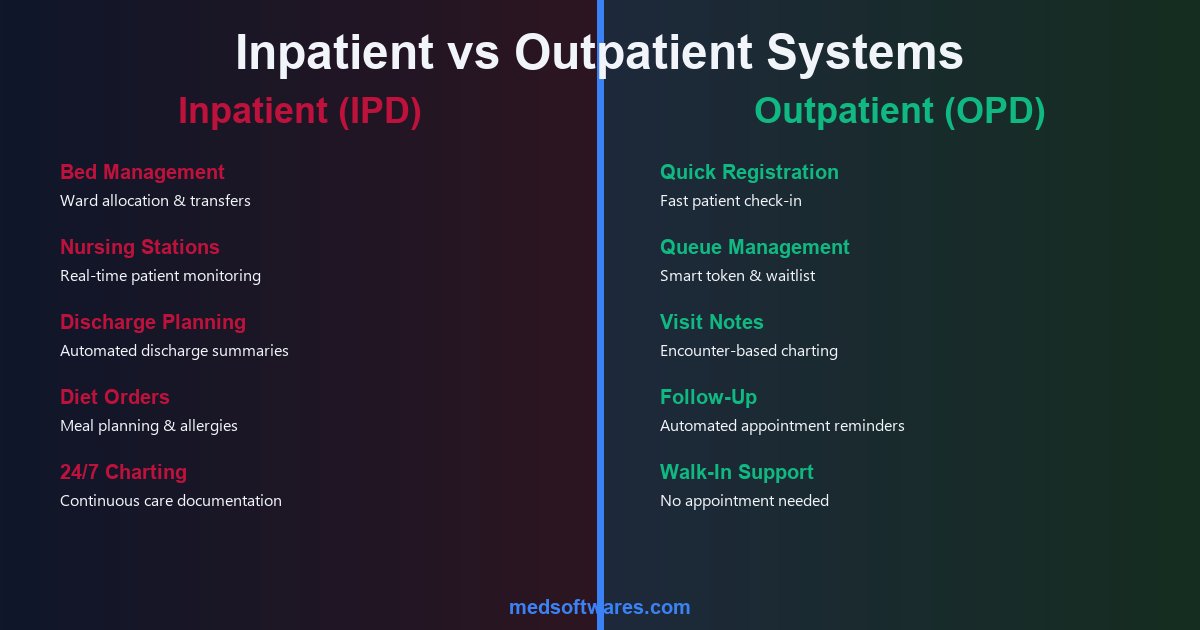
Quick Comparison: IPD vs OPD Management Systems
| Feature | Inpatient (IPD) | Outpatient (OPD) | |---------|-----------------|-------------------| | Patient Duration | Hours to weeks (avg 4-6 days) | Minutes to hours (single visit) | | Space Management | Bed management & ward allocation | Queue management & room scheduling | | Admission Process | Formal admission with bed assignment | Registration/check-in per visit | | Clinical Documentation | Nursing charts, flowsheets, orders | Encounter notes, SOAP format | | Medication Management | MAR (Medication Administration Record) | Prescriptions (Rx) for pharmacy fill | | Billing Model | Per-diem, DRG, bundled, case rate | Per-visit, CPT-coded, fee-for-service | | Monitoring | Continuous (vitals q4h, I&O, assessments) | Point-in-time (vitals at visit) | | Staffing | 24/7 nursing coverage | Clinic hours only | | Discharge Planning | Complex (follow-up, home health, rehab) | Simple (return visit scheduling) | | Cost per Episode | $2,000 - $50,000+ | $100 - $1,500 |
Understanding Inpatient (IPD) Management Systems
What is an Inpatient Management System?
An inpatient management system (also called IPD module, ADT system, or hospital ward management) handles all workflows related to patients who are formally admitted to the hospital and occupy a bed. These patients require continuous care, monitoring, and documentation throughout their stay.
Core IPD Workflows
1. Admission Management
The admission process is the gateway to inpatient care:
- Pre-admission: Insurance verification, pre-authorization, pre-operative testing
- Emergency admission: Rapid bed assignment from ED, trauma protocols
- Scheduled admission: Planned surgical or medical admissions
- Direct admission: Physician-ordered admission bypassing ED
- Transfer admission: Patient arriving from another facility
Admission Data Captured:
- Patient demographics and emergency contacts
- Insurance and pre-authorization details
- Admitting diagnosis (ICD-10)
- Attending physician assignment
- Level of care (ICU, step-down, med-surg, telemetry, rehab)
- Advance directives and code status
- Allergies and medication reconciliation
- Isolation precautions
2. Bed Management
Bed management is the heart of IPD operations:
- Real-time bed board: Visual display of all beds by unit, showing occupied, available, dirty, blocked, reserved
- Bed assignment logic: Matching patient acuity to appropriate unit and bed type
- Isolation management: Negative pressure rooms, contact/droplet/airborne precautions
- Bed turnaround tracking: Time from discharge to clean to ready for next patient
- Capacity alerts: Census thresholds triggering diversion or discharge push protocols
Bed Types Managed:
- ICU beds (medical, surgical, cardiac, neuro, pediatric)
- Step-down/progressive care beds
- Medical-surgical beds
- Telemetry beds
- Labor and delivery beds
- Pediatric beds
- Psychiatric beds
- Rehabilitation beds
- Private vs. semi-private rooms
3. Nursing Documentation (Inpatient)
Inpatient nursing documentation is extensive and continuous:
- Nursing assessments: Head-to-toe assessments every shift (or more frequently)
- Vital signs: Scheduled q4h, q2h, q1h, or continuous monitoring
- Intake and output (I&O): Fluid balance tracking (IV fluids, oral intake, urine, drains)
- Medication administration record (MAR): Documenting every medication given with time and route
- Pain assessments: Regular pain scoring and intervention documentation
- Fall risk assessments: Morse Fall Scale or similar, updated each shift
- Skin assessments: Braden Scale for pressure injury risk
- Care plans: Individualized nursing care plans with goals and interventions
- Restraint documentation: If applicable, required monitoring at defined intervals
4. Physician Orders (Inpatient)
- Admission order sets: Standardized orders for common diagnoses (CHF, pneumonia, hip replacement)
- Medication orders: Scheduled, PRN, and one-time medications with dosing parameters
- Laboratory orders: Stat, routine, and recurring lab tests
- Imaging orders: X-ray, CT, MRI, ultrasound
- Dietary orders: NPO, clear liquids, regular, therapeutic diets
- Activity orders: Bed rest, ambulate with assistance, physical therapy
- Nursing orders: Vital sign frequency, I&O, wound care, foley care
- Consult orders: Specialty consultations
5. Discharge Management
Discharge is a complex, multi-step process:
- Discharge planning: Begins at admission, coordinated by case management
- Discharge orders: Physician writes discharge medications, instructions, follow-up
- Medication reconciliation: Comparing admission meds to discharge meds
- Patient education: Discharge instructions, medication teaching, warning signs
- Follow-up scheduling: Post-discharge appointments booked before patient leaves
- Disposition: Home, skilled nursing facility, rehab, long-term care, hospice, AMA
- Discharge summary: Dictated or templated summary of stay for PCP and specialists
Understanding Outpatient (OPD) Management Systems
What is an Outpatient Management System?
An outpatient management system (also called OPD module, clinic management system, or ambulatory care software) handles workflows for patients who visit for scheduled or walk-in appointments and leave the same day. These encounters are typically shorter, more focused, and follow a different documentation and billing pattern.
Core OPD Workflows
1. Appointment Scheduling
Appointment management is the backbone of OPD:
- Online booking: Patient self-scheduling through web portal or mobile app
- Phone scheduling: Staff-assisted appointment booking
- Walk-in management: Same-day visits without prior appointment
- Recurring appointments: Follow-up series (weekly physical therapy, monthly chronic care)
- Multi-provider scheduling: Coordinating visits across specialists in a single trip
- Resource scheduling: Rooms, equipment, procedures requiring specific resources
- Automated reminders: SMS, email, and phone reminders reducing no-shows
2. Queue Management
OPD replaces bed management with queue management:
- Check-in kiosks: Patient self-check-in with demographics verification
- Digital queue display: Waiting room screens showing queue position (by number, not name for privacy)
- Token system: Numbered tokens for walk-in clinics
- Estimated wait times: Dynamic calculation based on current queue and provider pace
- Priority queuing: Urgent cases, elderly, pregnant, and VIP fast-track
- Multi-queue support: Different queues for registration, vitals, doctor, lab, pharmacy, billing
- Real-time status tracking: Staff dashboard showing patient journey through the visit
3. Clinical Documentation (Outpatient)
Outpatient documentation focuses on the encounter:
- SOAP notes: Subjective, Objective, Assessment, Plan format
- Chief complaint and HPI: Focused history of present illness
- Review of systems: Targeted rather than comprehensive
- Physical exam: Focused exam relevant to chief complaint
- Assessment and diagnosis: ICD-10 coding at the encounter level
- Plan: Medications prescribed, labs ordered, imaging ordered, referrals, follow-up instructions
- Procedure notes: If minor procedures performed (skin biopsy, injection, wound care)
- Visit summary: Printed or electronic summary for patient at check-out
4. Prescription Management (Outpatient)
Unlike inpatient MAR, outpatient focuses on prescriptions:
- E-prescribing: Electronic prescription sent directly to patient's pharmacy
- Medication list management: Current medication review and update
- Drug interaction checking: Real-time alerts for contraindications
- Formulary checking: Insurance formulary verification for coverage
- Refill management: Prescription refill requests from patients and pharmacies
- Prior authorization: Electronic submission for medications requiring approval
5. Referral Management
Outpatient systems handle the referral lifecycle:
- Internal referrals: PCP to specialist within the same organization
- External referrals: To outside specialists, labs, imaging centers
- Referral tracking: Status monitoring (sent, received, scheduled, completed)
- Referral authorization: Insurance pre-authorization management
- Report receipt: Tracking consultant reports and results
- Closed-loop communication: Ensuring referring provider receives findings
Detailed Feature Comparison: IPD vs OPD
Space and Resource Management
| Aspect | Inpatient (IPD) | Outpatient (OPD) | |--------|-----------------|-------------------| | Primary resource | Hospital beds | Exam rooms & time slots | | Capacity unit | Census (occupied beds) | Visits per day | | Utilization metric | Bed occupancy rate (target 80-85%) | Provider schedule utilization (target 90%+) | | Overbooking | Not possible (physical bed constraint) | Common practice (double-booking slots) | | Duration variability | Hours to weeks | 15-60 minute appointments | | Housekeeping | Bed turnaround time critical | Room turnover between patients | | Equipment | Bedside monitors, IV poles, beds | Exam tables, basic diagnostic tools |
Clinical Documentation Comparison
| Documentation | Inpatient (IPD) | Outpatient (OPD) | |--------------|-----------------|-------------------| | Frequency | Continuous (every shift, q4h, etc.) | Per-visit only | | Notes format | Progress notes, nursing assessments | SOAP notes, encounter summaries | | Medication tracking | MAR (every dose documented) | Prescriptions written at visit | | Vital signs | Multiple times daily, trending | Once at visit check-in | | Lab/imaging | Ongoing during stay | Ordered, results reviewed at follow-up | | Care plans | Multi-day, multi-disciplinary | Visit-specific, focused | | Length | Extensive (100+ pages for long stays) | Concise (1-3 pages per visit) |
Billing and Revenue Cycle Comparison
| Billing Aspect | Inpatient (IPD) | Outpatient (OPD) | |---------------|-----------------|-------------------| | Payment model | DRG, per-diem, case rate | Fee-for-service, per-visit | | Coding | MS-DRG, APR-DRG | CPT/HCPCS + ICD-10 | | Claim type | UB-04 (institutional) | CMS-1500 (professional) | | Revenue per encounter | $5,000 - $50,000+ | $100 - $1,500 | | Payment timeline | 30-90 days post-discharge | 14-45 days post-visit | | Pre-authorization | Usually required for admission | Sometimes required for procedures | | Bundled services | Room, nursing, meals, routine meds included | Each service billed separately | | Observation vs. inpatient | Critical distinction for payment | N/A |
Staffing Model Comparison
| Staffing | Inpatient (IPD) | Outpatient (OPD) | |----------|-----------------|-------------------| | Hours | 24/7/365 | Clinic hours (8-12 hours/day) | | Nurse-to-patient ratio | 1:1 (ICU) to 1:6 (med-surg) | 1 nurse supports multiple providers | | Physician coverage | Hospitalists, on-call specialists | Scheduled clinic providers | | Support staff | Unit clerks, CNAs, respiratory, PT | Medical assistants, front desk | | Shift structure | 8 or 12-hour shifts with handoffs | Standard business day shifts |
When to Choose Inpatient vs Outpatient Software
You Need an IPD System If:
- Your facility has hospital beds where patients stay overnight
- You manage admissions, transfers, and discharges (ADT)
- Nurses perform continuous monitoring with regular vital signs and assessments
- You bill using DRG or per-diem payment models
- You need bed management and census tracking
- Your staff works 24/7 shifts with handoff communication needs
- Patients receive inpatient medications administered by nursing staff
You Need an OPD System If:
- Your facility operates as a clinic, medical office, or outpatient center
- Patients visit for appointments and leave the same day
- You manage provider schedules and patient queues
- You bill using CPT codes and fee-for-service models
- You need appointment scheduling with reminders and no-show management
- Your providers write prescriptions for patients to fill at pharmacies
- Documentation follows encounter-based SOAP notes
You Need Both IPD and OPD If:
- You operate a full-service hospital with both inpatient wards and outpatient clinics
- Your hospital has ambulatory surgery (same-day procedures)
- Physicians see clinic patients and admitted patients within the same organization
- You need patients to transition seamlessly between ED to inpatient to outpatient follow-up
- Your facility includes observation units (which are technically outpatient)
Integrated IPD + OPD Systems: The Ideal Architecture
Why Integration Matters
Separate IPD and OPD systems create dangerous information silos:
- Duplicate patient records across systems
- Lost clinical information when patients transition between settings
- Billing errors from incorrect patient status classification
- Medication reconciliation gaps between inpatient and outpatient
- Provider frustration from logging into multiple systems
Benefits of a Unified Platform
An integrated system like HospitalOS provides:
- Single patient record across all care settings
- Seamless transitions: ED to inpatient to outpatient follow-up without data loss
- Unified medication list: Inpatient MAR and outpatient prescriptions in one view
- Cross-setting scheduling: Book outpatient follow-up before inpatient discharge
- Consolidated billing: IPD and OPD claims from one revenue cycle platform
- Unified reporting: Analytics across all care settings for population health
Workflow Example: Patient Journey Through Integrated System
- OPD Visit: Patient sees PCP for chest pain, referred to cardiologist
- OPD Specialist: Cardiologist orders stress test, finds abnormality
- Scheduled IPD Admission: Patient admitted for cardiac catheterization
- IPD Stay: Cath lab procedure, 2-day recovery, nursing documentation
- IPD Discharge: Medications reconciled, follow-up scheduled
- OPD Follow-Up: Cardiologist reviews results, adjusts medications
- Ongoing OPD: Chronic disease management with regular visits
In an integrated system, every step shares the same patient chart, with full visibility into medications, labs, imaging, and clinical notes across all settings.
Implementation Considerations
For IPD System Implementation
Key Configuration Steps:
- Define ward and bed structure (units, rooms, bed types)
- Configure admission workflows and order sets
- Build nursing assessment templates and flowsheets
- Set up medication administration protocols
- Configure discharge planning workflows
- Define billing rules for DRG, per-diem, and observation
- Establish bed management dashboards and alerts
Timeline: 12-24 weeks for full IPD implementation
For OPD System Implementation
Key Configuration Steps:
- Define provider schedules and appointment types
- Configure patient registration and check-in workflows
- Build encounter documentation templates (SOAP notes)
- Set up prescription management and e-prescribing
- Configure referral management workflows
- Define billing rules for CPT coding and claim submission
- Establish queue management and patient flow displays
Timeline: 8-16 weeks for full OPD implementation
For Integrated IPD + OPD Implementation
Additional Considerations:
- Unified patient master index across all settings
- Cross-setting provider access and privileges
- Medication reconciliation workflows at transitions of care
- Observation vs. inpatient status determination support
- Consolidated reporting across care settings
- Single sign-on for providers working in both settings
Timeline: 16-32 weeks for integrated implementation
ROI Comparison: IPD vs OPD Systems
Inpatient System ROI
| Benefit | Annual Value | |---------|-------------| | Reduced average length of stay | $500,000 - $2,000,000 | | Improved bed turnaround | $200,000 - $800,000 | | DRG optimization | $300,000 - $1,000,000 | | Reduced readmissions | $200,000 - $500,000 | | Nursing documentation efficiency | $100,000 - $300,000 |
Outpatient System ROI
| Benefit | Annual Value | |---------|-------------| | Reduced no-show rate | $50,000 - $200,000 | | Increased patient throughput | $100,000 - $500,000 | | Improved coding accuracy | $50,000 - $200,000 | | Faster claim submission | $30,000 - $100,000 | | Patient satisfaction improvement | Indirect (reputation, referrals) |
How to Choose the Right System
Key Decision Factors
1. Facility Type:
- Hospital with beds = IPD system required (with OPD for clinics)
- Ambulatory clinic only = OPD system sufficient
- Multi-facility health system = Integrated IPD + OPD platform
2. Integration Requirements:
- Does the system need to connect to existing EHR, lab, and imaging systems?
- Is bidirectional data flow needed between IPD and OPD modules?
- Do providers need a single login for both settings?
3. Billing Complexity:
- Do you bill both institutional (UB-04) and professional (CMS-1500) claims?
- Do you need observation management to prevent billing errors?
- Is DRG optimization a priority for inpatient revenue?
4. Scalability:
- Will you add new service lines (surgery, specialty clinics, urgent care)?
- Are there plans to expand to multiple locations?
- Do you need the system to handle growing patient volumes?
Why Consider HospitalOS for IPD and OPD Management
HospitalOS by MedSoftwares provides fully integrated inpatient and outpatient management within a single platform:
Inpatient Features:
- Bed management with real-time visual bed board
- Admission, transfer, and discharge (ADT) workflows
- Nursing documentation with assessments and flowsheets
- Physician order management with CPOE
- Medication administration record (MAR)
- Discharge planning with follow-up scheduling
Outpatient Features:
- Appointment scheduling with online booking and reminders
- Queue management with digital displays
- Encounter documentation with SOAP templates
- E-prescribing and medication management
- Referral tracking and management
- Multi-provider schedule optimization
Integration Advantages:
- Single patient record across IPD and OPD
- Seamless care transitions between settings
- Unified billing for institutional and professional claims
- Consolidated analytics and reporting
- One-time licensing with no recurring per-module fees
Why Healthcare Facilities Choose HospitalOS:
- One-time licensing -- no recurring subscription fees for separate IPD and OPD modules
- Offline capability -- both modules work during internet outages
- Integrated with PharmaOS for pharmacy management across settings
- Designed for global healthcare environments
- Scalable from small clinics (OPD only) to large hospitals (full IPD + OPD)
Request a demo to see how HospitalOS delivers unified inpatient and outpatient management in a single, affordable platform.
Future Trends: IPD and OPD Convergence
Hospital-at-Home Programs
Inpatient care is moving home:
- Acute care delivered in patient homes with remote monitoring
- Software must manage hospital-level documentation outside hospital walls
- Hybrid IPD/OPD workflows for patients "admitted" but not physically in the hospital
- Reimbursement models evolving to support hospital-at-home
Virtual Outpatient Care
Telehealth is permanent OPD infrastructure:
- Video visit scheduling alongside in-person appointments
- Hybrid visit workflows (vitals at home, consultation via video)
- Remote patient monitoring bridging OPD visits
- AI-assisted triage determining in-person vs. virtual visits
Observation Management
The gray area between IPD and OPD:
- Observation status management is critical for billing compliance
- Two-midnight rule tracking and alerts
- Utilization review integration for status determination
- Patient status reclassification workflows
Ambulatory Surgery Center Growth
Procedures shifting from IPD to OPD:
- Same-day surgeries increasingly performed in outpatient settings
- Software supporting procedure-focused OPD workflows
- Recovery room management without full inpatient admission
- 23-hour observation models
Conclusion
Choosing between inpatient and outpatient management systems -- or implementing both -- is one of the most important technology decisions a healthcare facility makes. Inpatient systems handle the complexity of multi-day stays with continuous monitoring, nursing documentation, and bundled billing. Outpatient systems manage the volume and velocity of clinic visits with appointment scheduling, queue management, and per-visit billing.
For facilities that provide both types of care, an integrated platform that unifies IPD and OPD within a single patient record is the gold standard. This eliminates information silos, ensures safe transitions of care, streamlines billing, and gives providers a complete view of each patient regardless of care setting.
Contact MedSoftwares to learn how HospitalOS provides seamless inpatient and outpatient management in one integrated platform designed for healthcare organizations worldwide.
![Patient Portal Software: Complete Guide for Hospitals & Clinics [2026]](/_next/image?url=%2Finfographics%2Fpatient-portal-benefits-stats.png&w=2048&q=75)

