

Orthopedic practices in 2026 face unique demands that general-purpose EHR and practice management systems simply cannot address. From advanced PACS imaging integration and 3D surgical planning to implant tracking and physical therapy coordination, orthopedic clinics need specialized software designed for musculoskeletal care. This guide covers everything you need to know about selecting, implementing, and maximizing orthopedic clinic management software.
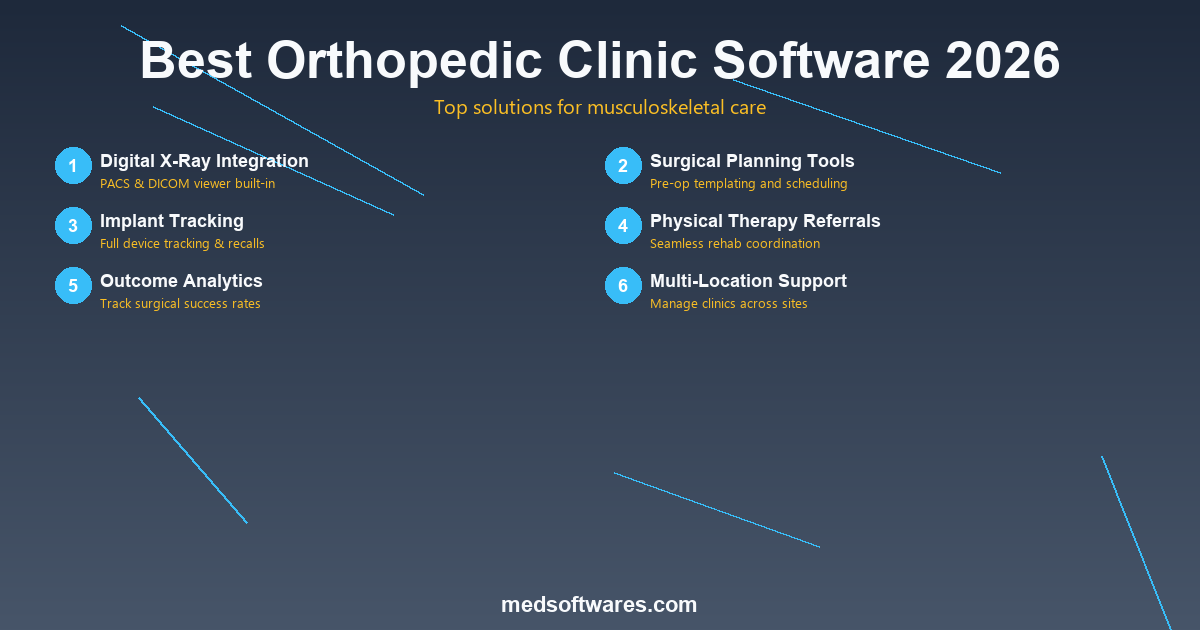
Quick Comparison: Top Orthopedic Software Platforms 2026
| Platform | Best For | PACS Integration | Implant Tracking | Surgical Planning | Pricing Model | |----------|----------|-----------------|-------------------|-------------------|---------------| | HospitalOS | Multi-specialty hospitals | Yes | Yes | Yes | One-time license | | Modernizing Medicine (ModMed) | Orthopedic specialists | Yes | Yes | Yes | Per-provider/month | | athenaOne Orthopedics | Mid-size practices | Yes | Limited | No | Subscription | | DrChrono Orthopedics | Small practices | Yes | Basic | No | Per-provider/month | | Nextech Orthopedics | Ambulatory surgery centers | Yes | Yes | Yes | Custom quote | | CureMD Orthopedics | Growing clinics | Yes | Yes | Limited | Subscription |
Why Orthopedic Practices Need Specialized Software
The Unique Challenges of Musculoskeletal Care
High Imaging Volume:
- Orthopedic practices generate 3-5x more imaging studies than primary care
- X-rays, MRIs, CT scans, and ultrasounds are core diagnostic tools
- Seamless PACS integration is non-negotiable for efficient workflows
Complex Surgical Documentation:
- Detailed operative reports with implant specifications
- Pre-operative planning with templating and measurement tools
- Post-operative follow-up tracking and outcome measurement
Multi-Disciplinary Coordination:
- Orthopedic surgeons, sports medicine physicians, and physiatrists
- Physical therapy and rehabilitation referrals
- Pain management coordination
- Occupational therapy integration
Regulatory and Compliance Needs:
- FDA implant tracking requirements (UDI compliance)
- Workers compensation documentation
- Motor vehicle accident case management
- MIPS/MACRA quality reporting for orthopedic measures
Essential Features of Orthopedic Clinic Software
1. PACS and Imaging Integration
Seamless Image Viewing:
- DICOM-compliant image viewing directly within the EHR
- Side-by-side comparison of pre and post-operative images
- Multi-modality support (X-ray, MRI, CT, ultrasound, bone density)
- Zero-footprint web viewers eliminating desktop software installations
Measurement and Annotation Tools:
- Digital goniometry for range-of-motion measurements
- Angle and distance measurement on radiographs
- Fracture classification templates (AO/OTA, Neer, Garden)
- Spinal alignment measurement (Cobb angle, sagittal balance)
Image Management:
- Automated image routing from modalities to patient charts
- Cloud-based image archiving with redundant backup
- Referring physician image sharing via secure links
- AI-assisted fracture detection and flagging
2. Surgical Planning and Templating
Pre-Operative Planning:
- Digital templating for joint replacements (hip, knee, shoulder)
- 3D reconstruction from CT data for complex fractures
- Implant sizing and positioning simulation
- Patient-specific instrumentation (PSI) workflow support
Operative Documentation:
- Orthopedic-specific operative note templates
- Procedure-specific documentation (arthroscopy, arthroplasty, fracture fixation)
- Intraoperative image capture and annotation
- Implant catalog integration for quick selection and documentation
Surgical Case Management:
- Surgical scheduling with block time management
- Pre-authorization tracking and insurance verification
- Anesthesia coordination and clearance tracking
- Post-anesthesia care unit (PACU) documentation
3. Implant Tracking and Management
Unique Device Identification (UDI):
- FDA-mandated UDI capture and documentation
- Barcode scanning for implant identification
- Lot number, serial number, and expiration tracking
- Automated recall notification system
Implant Inventory:
- Par level management for commonly used implants
- Consignment inventory tracking with vendor coordination
- Cost analysis per procedure and per surgeon
- Wastage and expiration reporting
Outcome Tracking:
- Implant survivorship analysis
- Revision rate monitoring by implant type and manufacturer
- Patient-reported outcome measures (PROMs) linked to implants
- Registry data submission (AJRR, AAOS)
4. Injury Documentation and Assessment
Musculoskeletal Exam Templates:
- Joint-specific examination templates (shoulder, knee, hip, spine, hand, foot)
- Range of motion documentation with visual diagrams
- Strength testing grading (0-5 scale)
- Special test documentation (Lachman, McMurray, Neer, Hawkins)
- Neurovascular assessment templates
Body Mapping:
- Interactive body diagrams for pain location documentation
- Click-to-document injury sites
- Bilateral comparison tools
- Serial assessment tracking showing progression
Injury Classification:
- Fracture classification systems (AO/OTA, Salter-Harris, Weber)
- Ligament injury grading (I, II, III)
- Muscle and tendon injury grading
- Nerve injury classification (Seddon, Sunderland)
5. Physical Therapy Referral Management
Integrated PT Referrals:
- One-click referral generation to in-house or external PT clinics
- Automated prescription creation with diagnosis, precautions, and goals
- Treatment protocol templates by condition and surgery type
- Progress note sharing between orthopedist and physical therapist
Therapy Tracking:
- Visit count tracking against authorized visits
- Functional outcome measurement (DASH, LEFS, ODI, VAS)
- Milestone tracking and discharge criteria monitoring
- Re-evaluation alerts and follow-up scheduling
Rehabilitation Protocols:
- Post-surgical protocol libraries (ACL reconstruction, rotator cuff repair, TKA, THA)
- Customizable progression timelines
- Patient-facing exercise libraries with images and videos
- Home exercise program generation and tracking
6. Casting, Splinting, and DME Workflows
Procedure Documentation:
- Casting and splinting templates with material type, padding, and position
- Reduction documentation with pre and post-reduction imaging
- DME (durable medical equipment) ordering and tracking
- Brace fitting and prescription documentation
DME Management:
- In-office DME inventory management
- HCPCS coding for DME billing
- Certificate of medical necessity generation
- Insurance pre-authorization workflows
Orthopedic-Specific Billing and Coding
Complex Coding Requirements
Surgical Coding:
- CPT codes for fracture care (closed reduction, ORIF, external fixation)
- Arthroscopy procedure codes with proper modifier usage
- Joint replacement coding (27447 TKA, 27130 THA, 23472 TSA)
- Spine surgery coding (laminectomy, fusion, disc replacement)
- Modifier usage: -59 distinct procedural service, -RT/-LT laterality
Evaluation and Management:
- Office visits with complexity modifiers
- Workers compensation coding differences
- Motor vehicle accident documentation and billing
- Global period management for surgical follow-ups
Injection and Procedure Coding:
- Joint injections (20610, 20611) with image guidance codes
- Aspiration procedures
- PRP and regenerative medicine coding
- Fracture care management codes
Revenue Cycle Optimization
Pre-Authorization:
- Automated insurance verification for surgical procedures
- Prior authorization tracking dashboards
- Peer-to-peer review scheduling and documentation
- Appeal management for denied authorizations
Claim Accuracy:
- Real-time coding validation with ICD-10 and CPT cross-checks
- NCCI edit checking to prevent bundling errors
- Modifier validation and prompt
- Global period tracking to prevent unbundling
Sports Medicine Software Features
Athletic Injury Management
Athlete Profiles:
- Sport-specific injury risk profiles
- Concussion history and baseline testing documentation
- Pre-participation physical examination templates
- Return-to-play protocol tracking
Concussion Management:
- SCAT6 (Sport Concussion Assessment Tool) digital documentation
- ImPACT baseline and post-injury comparison
- Graduated return-to-play protocol tracking
- Academic accommodation documentation for student athletes
Team Medicine Integration:
- Multi-athlete management dashboards
- Team injury reports and trend analysis
- Sideline documentation on mobile devices
- Communication with coaches and athletic trainers
Regenerative Medicine
Treatment Documentation:
- PRP (platelet-rich plasma) preparation and injection documentation
- Stem cell therapy protocols and consent tracking
- Prolotherapy treatment records
- Viscosupplementation injection tracking
Leading Orthopedic Software Platforms 2026
1. HospitalOS Orthopedic Module
Best For: Hospitals and multi-specialty clinics with orthopedic departments
Key Features:
- Full PACS/DICOM integration for seamless imaging workflows
- Implant tracking with UDI compliance and inventory management
- Surgical planning and operative documentation templates
- Physical therapy referral and progress tracking
- Sports medicine and injury documentation modules
- PharmaPos integration for medication and DME dispensing
Pricing: One-time licensing fee, no recurring subscription Deployment: On-premise or cloud, offline-capable Global Support: Ideal for orthopedic clinics in emerging markets
2. Modernizing Medicine (ModMed) Orthopedics
Best For: Specialty orthopedic practices in North America
Key Features:
- Built specifically for orthopedic workflows from the ground up
- Adaptive learning documentation engine
- Integrated PM and billing
- MIPS dashboard for quality reporting
Pricing: $700-$1,000 per provider/month Deployment: Cloud-based
3. Nextech Orthopedics
Best For: Ambulatory surgery centers and surgical practices
Key Features:
- ASC workflow optimization
- Implant log and tracking
- Practice analytics and benchmarking
- Marketing automation for patient acquisition
Pricing: Custom quote based on practice size Deployment: Cloud or on-premise
4. DrChrono Orthopedics
Best For: Small to mid-size orthopedic practices
Key Features:
- iPad-native EHR with drawing and annotation
- Custom orthopedic templates
- Integrated telehealth
- Revenue cycle management
Pricing: $400-$600 per provider/month Deployment: Cloud-based
5. CureMD Orthopedics
Best For: Growing orthopedic clinics seeking scalability
Key Features:
- AI-assisted clinical documentation
- Orthopedic-specific content library
- Patient portal with exercise tracking
- Interoperability with imaging centers
Pricing: $350-$600 per provider/month Deployment: Cloud-based
Implementation Roadmap for Orthopedic Software
Phase 1: Assessment and Planning (Weeks 1-4)
- Audit current workflows -- Document existing processes for patient intake, imaging, surgical scheduling, and billing
- Identify pain points -- Survey physicians, PAs, medical assistants, and billing staff
- Define requirements -- Prioritize must-have features vs. nice-to-have capabilities
- Budget planning -- Include software, hardware, training, and productivity loss during transition
Phase 2: Vendor Selection (Weeks 4-8)
- Request demos from shortlisted vendors with orthopedic-specific scenarios
- Test PACS integration with your existing imaging equipment
- Verify implant catalog compatibility with your preferred vendors
- Check references from similar-sized orthopedic practices
- Negotiate contracts with clear SLAs for uptime and support
Phase 3: Configuration and Data Migration (Weeks 8-14)
- Build orthopedic templates -- Customize exam, operative, and procedure note templates
- Configure implant catalogs -- Load preferred implant manufacturer catalogs
- Set up PACS integration -- Connect imaging modalities and verify DICOM routing
- Migrate patient data -- Transfer demographics, surgical history, and active treatment plans
- Configure billing rules -- Set up fee schedules, payer contracts, and coding preferences
Phase 4: Training (Weeks 14-16)
- Physician training -- Focus on documentation efficiency, templating, and order entry
- Clinical staff training -- Intake workflows, imaging coordination, and referral management
- Billing team training -- Coding workflows, claim submission, and denial management
- Super-user certification -- Identify and train power users for ongoing support
Phase 5: Go-Live and Optimization (Weeks 16+)
- Phased rollout -- Start with scheduling and registration, then add clinical documentation
- At-the-elbow support during the first two weeks of full operation
- Weekly optimization reviews -- Identify and resolve workflow inefficiencies
- 90-day benchmark -- Compare documentation time, claim accuracy, and patient throughput
Key Metrics for Orthopedic Practice Performance
Clinical Efficiency
| Metric | Industry Benchmark | Top Performers | |--------|-------------------|----------------| | Patients per day per provider | 18-22 | 25-30 | | Average documentation time per visit | 8-12 minutes | 4-6 minutes | | Imaging result turnaround | 24-48 hours | Same day | | PT referral completion rate | 60-70% | 85-95% | | Surgical case documentation time | 15-20 minutes | 8-12 minutes |
Financial Performance
| Metric | Industry Benchmark | Top Performers | |--------|-------------------|----------------| | Days in A/R | 35-45 | 25-30 | | Clean claim rate | 85-90% | 95-98% | | Charge capture rate | 90-95% | 98-100% | | Authorization denial rate | 10-15% | 3-5% | | Collections per visit | $180-$250 | $280-$350 |
How to Choose the Right Orthopedic Software
Step 1: Evaluate Your Practice Type
- Solo or small group -- Prioritize ease of use and cost efficiency
- Multi-location practice -- Focus on centralized management and reporting
- Hospital-based department -- Ensure integration with hospital HIS/EHR
- Ambulatory surgery center -- Look for ASC-specific workflows
- Sports medicine focus -- Require athlete management and concussion protocols
Step 2: Assess Integration Requirements
- PACS/RIS compatibility -- Confirm DICOM compliance and worklist integration
- Implant vendor catalogs -- Verify your preferred manufacturers are supported
- Physical therapy systems -- Check bidirectional data sharing capabilities
- Billing clearinghouses -- Ensure seamless claim submission
- Hospital systems -- HL7/FHIR interoperability for referrals and results
Step 3: Calculate Total Cost of Ownership
- Licensing fees -- One-time purchase vs. monthly subscription
- Implementation costs -- Data migration, customization, and training
- Hardware requirements -- Workstations, scanners, and imaging equipment
- Ongoing costs -- Support, updates, and additional user licenses
- Hidden costs -- Custom report development, interface fees, downtime
Step 4: Prioritize User Experience
- Mobile access -- Can surgeons document from the OR or clinic floor?
- Voice dictation -- Does the system support Dragon or built-in speech recognition?
- Template efficiency -- How many clicks does it take to complete a common note?
- Imaging access -- Can images be viewed without leaving the EHR?
Why Consider HospitalOS for Orthopedic Practice Management
HospitalOS provides a comprehensive orthopedic clinic management solution that eliminates the limitations of generic EHR platforms:
- Full PACS/DICOM integration for seamless imaging workflows within the clinical chart
- Implant tracking and UDI compliance to meet FDA requirements and optimize inventory
- Surgical planning tools with digital templating and 3D visualization support
- Physical therapy coordination with integrated referral and progress tracking
- One-time licensing with no recurring monthly fees, ideal for cost-conscious practices
- Offline capability ensuring uninterrupted care even during connectivity disruptions
- PharmaPos integration for in-house pharmacy and DME dispensing
Contact our team to schedule a personalized demo tailored to your orthopedic practice workflows and see how HospitalOS can transform your musculoskeletal care delivery.
![Clinic Appointment Scheduling Software: Complete Guide [2026]](/_next/image?url=%2Finfographics%2Fclinic-scheduling-benefits-2026.png&w=2048&q=75)
![Affordable EMR Software for Small Clinics: Complete Guide [2026]](/_next/image?url=%2Finfographics%2Femr-small-clinics-stats.png&w=2048&q=75)
![mHealth Mobile Apps for Hospitals & Clinics: Complete Guide [2026]](/_next/image?url=%2Finfographics%2Fmhealth-apps-market-2026.png&w=2048&q=75)