

Supply chain costs represent the second-largest expense for hospitals, accounting for 30-40% of total operating budgets. In 2026, healthcare supply chain disruptions, rising material costs, and margin pressures make sophisticated supply chain management software essential. This guide covers the full spectrum of healthcare supply chain technology -- from procurement and vendor management to inventory optimization and recall response.
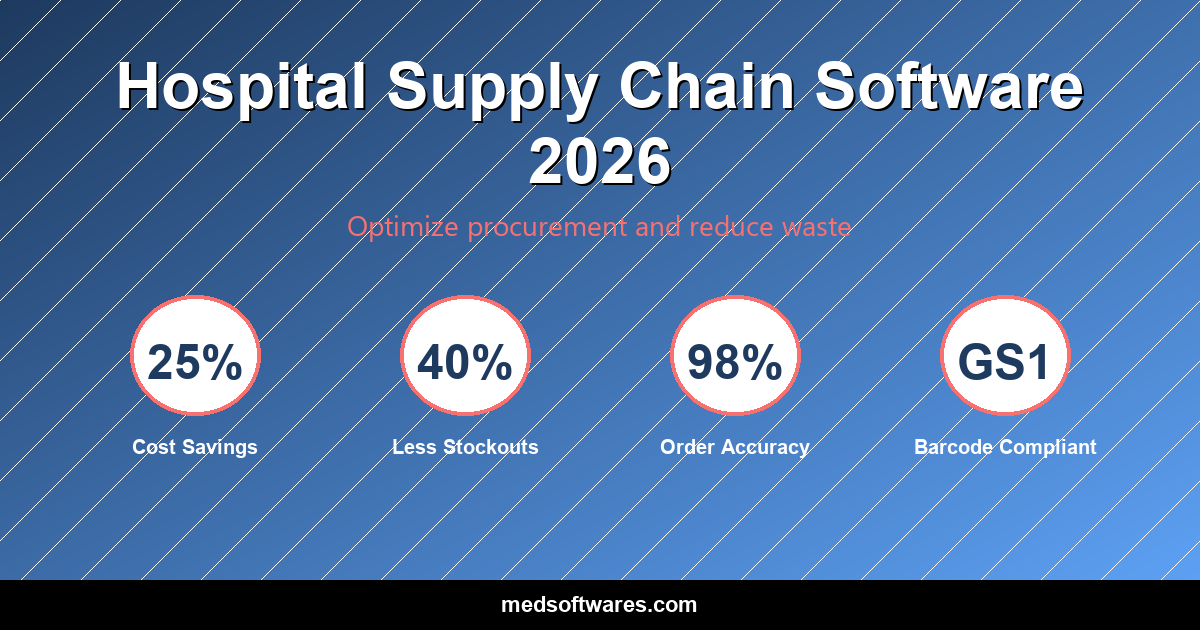
Quick Comparison: Hospital Supply Chain Software 2026
| Platform | Best For | GPO Integration | GS1 Barcoding | Contract Mgmt | Recall Mgmt | Pricing | |----------|----------|----------------|---------------|--------------|-------------|---------| | HospitalOS Supply Chain | Global hospitals | Yes | Yes | Yes | Yes | One-time license | | Infor CloudSuite Healthcare | Large health systems | Yes | Yes | Yes | Yes | Enterprise subscription | | Oracle Health Supply Chain | Enterprise hospitals | Yes | Yes | Yes | Yes | Enterprise pricing | | Tecsys Elite Healthcare | Mid-large hospitals | Yes | Yes | Yes | Yes | Subscription | | GHX Exchange | Procurement focus | Yes | Yes | Yes | Limited | Transaction-based | | Syft Analytics | Spend analytics | Yes | No | Yes | No | Subscription | | Par Excellence | PAR automation | No | Yes | No | No | Per-unit pricing |
The Healthcare Supply Chain Crisis in 2026
Why Supply Chain Management Matters Now More Than Ever
The past several years have fundamentally changed how hospitals think about their supply chains:
- Post-pandemic vulnerabilities exposed single-source dependencies
- Product shortages affecting 30%+ of hospitals for critical supplies
- Price inflation -- medical supply costs up 15-25% since 2020
- Labor shortages in materials management departments
- Regulatory requirements for tracking medical devices and pharmaceuticals
- Sustainability mandates requiring supply chain transparency
The Financial Impact of Poor Supply Chain Management
| Issue | Annual Cost Impact (300-bed hospital) | |-------|--------------------------------------| | Excess inventory carrying costs | $1.5-3M | | Expired/wasted supplies | $500K-1.2M | | Missed contract pricing | $800K-2M | | Stockouts requiring emergency orders | $300K-750K | | Manual process labor costs | $400K-800K | | Recall response inefficiency | $100K-500K | | Total Addressable Waste | $3.6-8.25M |
Essential Hospital Supply Chain Software Features
1. Procurement and Purchase Order Management
Streamline the buying process from requisition to receipt:
- Electronic requisitioning with approval workflows
- Purchase order generation with automatic vendor routing
- Catalog management with contracted pricing enforcement
- Punch-out integration with major distributor catalogs
- Three-way matching (PO, receipt, invoice) for payment accuracy
- Spend analytics identifying savings opportunities
- Budget tracking by department and cost center
Procurement Workflow:
Requisition → Approval → PO Generation → Vendor Transmission → Receiving → Invoice Match → Payment
2. Vendor Management
Manage relationships with hundreds of suppliers:
- Vendor master database with contact, contract, and performance data
- Vendor scorecards tracking delivery, quality, and pricing performance
- Diversity tracking for minority and local supplier goals
- Vendor credentialing and compliance documentation
- Communication portal for order inquiries and issue resolution
- New vendor onboarding workflows with required documentation
Vendor Performance Metrics:
| Metric | Target | Measurement | |--------|--------|-------------| | On-time delivery rate | >95% | Orders received by promised date | | Fill rate | >98% | Items shipped vs. items ordered | | Quality defect rate | <1% | Returns/complaints per 1,000 units | | Invoice accuracy | >99% | Correct invoices vs. total invoices | | Response time | <24 hours | Time to respond to inquiries | | Contract compliance | >95% | Orders at contracted pricing |
3. Group Purchasing Organization (GPO) Integration
Leverage collective buying power:
- GPO contract catalog integration (Vizient, Premier, HPG, Intalere)
- Contract tier tracking ensuring volume commitments are met
- Price benchmarking against GPO contract pricing
- Compliance reporting to GPO for rebate qualification
- Multi-GPO management for hospitals with multiple memberships
- Local contract overlay for regional agreements
- Contract expiration alerts preventing lapses in pricing
4. Inventory Management and Par Level Optimization
Right-size inventory across the hospital:
- Par level management by location (OR, nursing units, cath lab, pharmacy)
- Automated par optimization using consumption data and lead times
- Cycle counting programs replacing annual physical inventories
- ABC/XYZ analysis categorizing items by value and demand variability
- Safety stock calculations based on lead time variability
- Kanban/two-bin systems for high-turnover supplies
- Consignment inventory tracking for implants and high-value devices
Inventory Optimization Impact:
| Metric | Before Optimization | After Optimization | |--------|-------------------|--------------------| | Total inventory value | $8-12M | $5-7M | | Inventory turns per year | 6-8x | 12-18x | | Stockout rate | 8-15% | 1-3% | | Expired product waste | 3-5% | <1% | | Emergency orders | 10-15% of purchases | 2-4% of purchases | | Carrying cost (% of value) | 25-35% | 15-20% |
5. GS1 Barcoding and Item Identification
Standardized identification for supply chain accuracy:
- GS1-128 barcode scanning at receiving and point of use
- GTIN (Global Trade Item Number) for product identification
- GLN (Global Location Number) for location tracking
- UDI (Unique Device Identification) capture for medical devices
- Lot and serial number tracking for traceability
- Expiration date capture at scanning
- Integration with FDA GUDID (Global Unique Device Identification Database)
6. Contract Management
Maximize value from purchasing agreements:
- Contract repository with searchable terms and conditions
- Price file management with automatic updates
- Tier tracking monitoring volume-based pricing thresholds
- Commitment tracking ensuring contract compliance
- Rebate management calculating and tracking earned rebates
- Renewal alerts with lead time for renegotiation
- Savings reporting quantifying contract value vs. list pricing
7. Value Analysis and Product Standardization
Data-driven product decisions:
- Product utilization analysis across departments and physicians
- Clinical evidence review for product evaluation
- Total cost of ownership calculations (not just unit price)
- Physician preference item (PPI) management and standardization
- Trial tracking for new product evaluations
- Conversion analysis calculating savings from product switches
- Committee management for value analysis team workflows
8. Recall Management
Respond to product recalls swiftly and completely:
- FDA recall alert integration with automatic notifications
- Affected inventory identification by lot number and location
- Patient impact assessment linking recalled products to patients
- Quarantine workflow isolating affected products from use
- Vendor communication automating return authorization
- Regulatory reporting documenting recall response
- Root cause tracking for recurring vendor quality issues
Recall Response Timeline:
| Action | Without Software | With Software | |--------|-----------------|---------------| | Receive recall notification | Manual (hours-days) | Automatic (minutes) | | Identify affected inventory | 4-24 hours | 15-30 minutes | | Quarantine affected products | 1-3 days | Same day | | Identify affected patients | 2-7 days | 1-4 hours | | Complete vendor return | 2-4 weeks | 3-7 days | | Regulatory documentation | Manual compilation | Auto-generated |
9. Warehouse and Distribution Management
Manage central supply and distribution:
- Warehouse management with bin location tracking
- Pick, pack, and ship workflows for internal distribution
- Par replenishment automation from central warehouse to departments
- Cart exchange systems with automatic reorder
- Receiving dock management with appointment scheduling
- Cross-docking for direct-to-department deliveries
- Returns processing with vendor credit tracking
10. Analytics and Reporting
Data-driven supply chain decision-making:
- Spend dashboards showing purchasing trends by category, vendor, and department
- Contract savings reports quantifying GPO and local contract value
- Inventory health reports highlighting excess, slow-moving, and expired stock
- Vendor performance scorecards and trend analysis
- Budget variance reporting by cost center
- Benchmarking against peer hospitals and industry standards
- Predictive analytics forecasting demand and identifying risks
Supply Chain KPIs Every Hospital Should Track
| KPI Category | Metric | Target | Why It Matters | |-------------|--------|--------|---------------| | Cost | Supply cost per adjusted discharge | Trending down | Overall cost efficiency | | Cost | Purchased services as % of revenue | <15% | Cost containment | | Inventory | Inventory turns | 12-18x/year | Working capital efficiency | | Inventory | Days of inventory on hand | 20-30 days | Balance cost vs. availability | | Quality | Stockout rate | <2% | Clinical impact | | Quality | Product recall response time | <4 hours | Patient safety | | Process | PO cycle time (req to PO) | <24 hours | Procurement efficiency | | Process | Invoice match rate | >95% | Accounts payable efficiency | | Contract | Contract utilization rate | >85% | Savings realization | | Contract | Off-contract purchasing | <10% | Contract compliance |
Implementation Guide: Hospital Supply Chain Software
Phase 1: Assessment and Strategy (Weeks 1-6)
Current State Analysis:
- Map existing procurement and inventory workflows
- Identify top spend categories and vendors
- Assess current technology (ERP, standalone tools, spreadsheets)
- Calculate baseline supply chain KPIs
- Document pain points from materials management, finance, and clinical staff
Strategy Development:
- Define supply chain vision and goals
- Prioritize improvement areas (cost, quality, efficiency)
- Establish governance structure (steering committee, project team)
- Create business case with ROI projections
Phase 2: Software Selection (Weeks 7-12)
Requirements Definition:
- Functional requirements by supply chain process
- Integration requirements (EHR, finance/ERP, GPO, distributors)
- Technical requirements (cloud vs. on-premise, mobile, offline)
- Vendor evaluation criteria and scoring model
Vendor Evaluation:
- Issue RFP to shortlisted vendors
- Conduct scripted demos with real-world scenarios
- Check references from similar-sized hospitals
- Negotiate pricing and contract terms
Phase 3: Implementation (Weeks 13-30)
Data Foundation:
- Cleanse and standardize item master data
- Map items to UNSPSC codes and GPO contract numbers
- Configure vendor master with current contracts
- Set up location hierarchy (buildings, departments, storage areas)
- Establish par levels based on historical consumption
System Configuration:
- Configure approval workflows and spending limits
- Set up integration feeds (EHR, finance, GPO, distributors)
- Build reporting dashboards and alert rules
- Configure barcode scanning devices and label printers
Phase 4: Training and Go-Live (Weeks 28-36)
Role-Based Training:
- Buyers/procurement -- Requisitioning, PO management, vendor communication
- Receiving staff -- Receipt processing, barcode scanning, put-away
- Materials management -- Par replenishment, cycle counting, inventory analysis
- Department managers -- Requisitioning, budget monitoring
- Finance team -- Invoice matching, spend reporting, contract analysis
Phase 5: Optimization (Ongoing)
- Monthly KPI review and goal setting
- Quarterly contract renegotiation based on data
- Semi-annual value analysis projects
- Annual strategic sourcing initiatives
- Continuous process improvement
How to Choose the Right Supply Chain Software
Critical Decision Factors
- Integration depth -- How well does it connect with your EHR, finance system, and GPO?
- Item master management -- Can it handle 50,000+ unique items with full attributes?
- GPO support -- Does it integrate with your specific GPO's contract catalogs?
- Barcode capability -- Does it support GS1 standards and UDI capture?
- Analytics maturity -- Basic reports or advanced predictive analytics?
- Scalability -- Can it grow with your health system (multi-site, mergers)?
- Mobile capability -- Do warehouse and receiving staff have mobile tools?
- Cloud vs. on-premise -- Which deployment model fits your IT strategy?
Common Pitfalls to Avoid
- Underestimating item master data cleanup -- Budget 30-40% of implementation time for data
- Skipping value analysis integration -- Software alone does not save money without process change
- Ignoring change management -- Materials management culture must evolve with new tools
- Choosing based on price alone -- Total cost of ownership includes implementation, training, and ongoing support
- Not involving clinical stakeholders -- Physician and nursing buy-in is critical for standardization
Cost Analysis: Supply Chain Software Investment
Total Cost of Ownership
| Component | Community Hospital (150 beds) | Regional Hospital (300 beds) | Health System (1,000+ beds) | |-----------|------------------------------|-----------------------------|-----------------------------| | Software license/subscription | $50K-150K/year | $150K-400K/year | $400K-1.5M/year | | Implementation | $75K-200K | $200K-500K | $500K-2M | | Data migration/cleanup | $25K-75K | $75K-200K | $200K-500K | | Training | $15K-40K | $40K-100K | $100K-250K | | Annual maintenance/support | $25K-75K | $75K-200K | $200K-500K | | Year 1 Total | $190K-540K | $540K-1.4M | $1.4M-4.75M |
ROI Calculation
300-Bed Hospital, $45M Annual Supply Spend:
| Savings Category | Conservative (%) | Annual Savings | |-----------------|------------------|----------------| | Contract compliance improvement | 2-3% | $900K-1.35M | | Inventory reduction (carrying cost) | 15-25% of inventory value | $375K-625K | | Waste/expiration reduction | 0.5-1% | $225K-450K | | Process automation (labor) | 10-20% of FTE cost | $150K-300K | | Emergency order elimination | 0.3-0.5% | $135K-225K | | Total Annual Savings | | $1.78M-2.95M |
Payback Period: 4-9 months
Emerging Trends in Healthcare Supply Chain (2026-2030)
AI and Machine Learning
- Demand forecasting predicting supply needs based on patient volume, seasonality, and procedure schedules
- Automated reordering with AI-optimized quantities and timing
- Anomaly detection identifying unusual consumption patterns (waste, theft, clinical variation)
- Supplier risk prediction monitoring vendor financial health and disruption signals
Supply Chain Resilience
- Dual/multi-source strategies reducing single-vendor dependency
- Strategic inventory buffers for critical items based on disruption modeling
- Near-shoring preferences for supply chain proximity
- Real-time supply visibility from manufacturer to point of use
Sustainability and ESG
- Carbon footprint tracking for supply chain decisions
- Sustainable sourcing preferences and reporting
- Waste reduction analytics minimizing environmental impact
- Circular economy initiatives for reprocessing and recycling
Blockchain and Traceability
- Drug supply chain verification meeting DSCSA requirements
- Device traceability from manufacturing through implantation
- Counterfeit prevention with tamper-proof supply chain records
- Smart contracts automating vendor payments on delivery verification
Why Consider HospitalOS for Supply Chain Management
HospitalOS by MedSoftwares includes a comprehensive supply chain management module designed for hospitals of all sizes:
- Complete procurement workflow from requisition through three-way matching
- GPO contract integration with pricing enforcement and compliance tracking
- Intelligent inventory management with par level optimization and ABC analysis
- GS1 barcode scanning at receiving and point of use for full traceability
- Recall management with automatic lot-level identification and patient impact analysis
- Vendor performance dashboards with scorecards and trend reporting
- Contract management with tier tracking, expiration alerts, and savings quantification
- One-time licensing with no per-transaction or per-user recurring fees
- Offline capability ensuring supply chain operations continue during connectivity disruptions
Seamlessly connect your supply chain to clinical operations through HospitalOS EHR integration, and manage pharmaceutical supply with PharmaPoS for end-to-end medication inventory control.
Ready to optimize your hospital's supply chain? Contact MedSoftwares to schedule a supply chain assessment and see how HospitalOS can reduce costs, prevent stockouts, and streamline your procurement operations.
![AI Pharmacy Inventory Prediction: How Machine Learning Prevents Stockouts [2026]](/_next/image?url=%2Finfographics%2Fai-inventory-prediction-stats.png&w=2048&q=75)
![Medical Inventory Management Software for Hospitals: Complete Guide [2026]](/_next/image?url=%2Finfographics%2Fmedical-inventory-management-stats.png&w=2048&q=75)
