

Healthcare organizations worldwide are investing billions in digital transformation, yet many struggle to quantify the return on these investments. In 2026, hospital boards and healthcare administrators demand data-driven justification for every technology dollar spent. This guide provides a comprehensive framework for measuring, forecasting, and maximizing the ROI of hospital digital transformation initiatives.
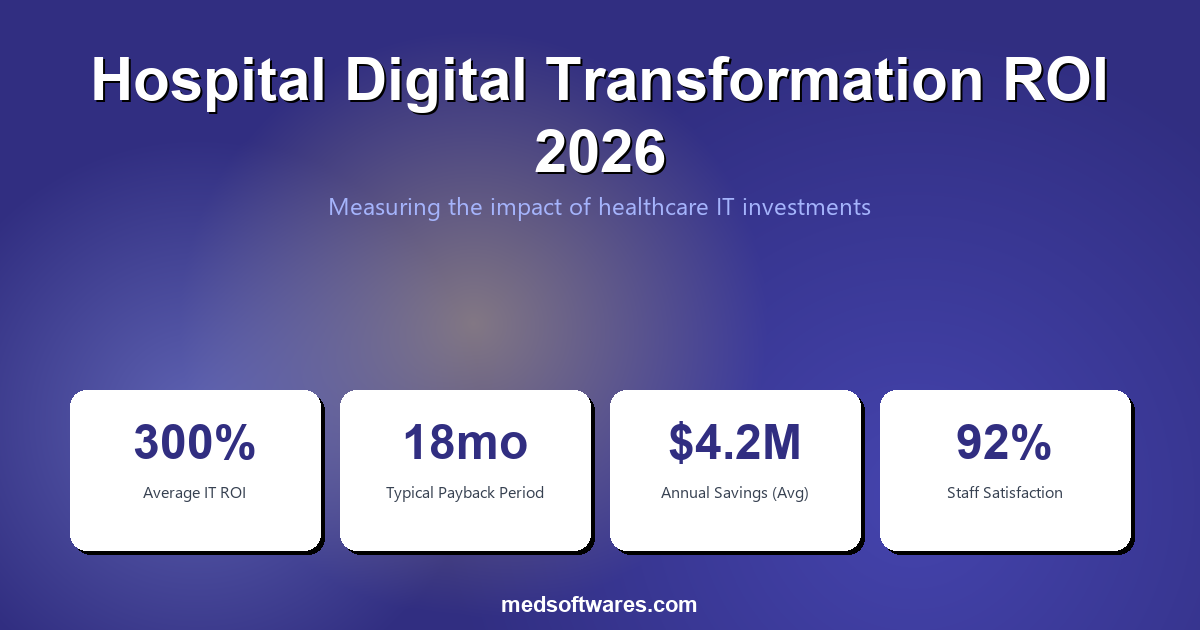
Quick Overview: Digital Transformation ROI by Technology Category
| Technology Category | Typical Investment | Average ROI Timeline | Expected ROI Range | Risk Level | |--------------------|-------------------|---------------------|-------------------|------------| | EHR/HMS Implementation | $500K-50M | 18-36 months | 150-400% over 5 years | Medium | | Revenue Cycle Management | $100K-2M | 6-12 months | 300-800% annually | Low | | Telehealth/RPM | $50K-500K | 3-9 months | 200-600% annually | Low | | Supply Chain Software | $200K-5M | 6-18 months | 200-500% over 3 years | Medium | | AI/Machine Learning | $100K-3M | 12-24 months | 150-1,000% over 5 years | High | | Cybersecurity | $200K-2M | Immediate (risk avoidance) | Prevention of $2-10M in breach costs | Low | | Patient Engagement | $50K-500K | 6-12 months | 100-300% over 3 years | Low-Medium | | Pharmacy Automation | $100K-1M | 6-12 months | 200-500% over 3 years | Low |
What Is Digital Transformation in Healthcare?
Hospital digital transformation is the strategic adoption of digital technologies to fundamentally improve clinical outcomes, operational efficiency, patient experience, and financial performance. It goes beyond simply digitizing existing processes -- true transformation reimagines how care is delivered and how the organization operates.
The Five Pillars of Healthcare Digital Transformation
- Clinical Transformation -- EHR, CPOE, clinical decision support, evidence-based protocols
- Operational Transformation -- Scheduling, supply chain, workforce management, facility optimization
- Financial Transformation -- Revenue cycle, cost accounting, predictive financial analytics
- Patient Experience Transformation -- Digital front door, self-service, communication, engagement
- Data and Analytics Transformation -- Business intelligence, AI/ML, population health, predictive modeling
Why ROI Measurement Is Critical
The Accountability Gap
- 76% of hospital CFOs say they cannot clearly quantify the ROI of recent IT investments
- $40 billion+ spent annually on healthcare IT in the US alone
- 60% of digital health projects fail to meet their original ROI projections
- 45% of hospitals have at least one "shelf-ware" technology they purchased but never fully implemented
Rigorous ROI measurement enables better investment decisions, board confidence through data-driven justification, vendor accountability, early identification of underperforming initiatives, and strategic alignment ensuring technology serves organizational goals.
The Healthcare IT ROI Framework
Step 1: Define the Investment
Capture the Total Cost of Ownership (TCO) for any digital transformation initiative:
Capital Costs (One-Time):
- Software licensing or purchase
- Hardware (servers, workstations, mobile devices, kiosks)
- Infrastructure upgrades (network, WiFi, data center)
- Implementation and configuration services
- Data migration and interface development
- Initial training and go-live support
Operating Costs (Recurring):
- Annual maintenance and support fees
- Subscription/SaaS fees
- Staff to operate and maintain the system
- Ongoing training for new employees
- Upgrades and enhancements
- Help desk and support
Hidden Costs (Often Overlooked):
- Productivity loss during implementation
- Change management and organizational readiness
- Opportunity cost of staff time diverted to the project
- Customization and workflow redesign
- Downtime and disruption during go-live
- Integration maintenance as connected systems change
Step 2: Identify and Quantify Benefits
Benefits fall into four categories:
A. Hard Financial Benefits (Directly Measurable)
| Benefit | Measurement Method | Example | |---------|-------------------|---------| | Revenue increase | Before/after revenue comparison | 15% increase in billable encounters | | Cost reduction | Expense line item reduction | $200K reduction in transcription costs | | Denial reduction | Claims denial rate change | Denials reduced from 12% to 4% | | Labor efficiency | FTE reduction or redeployment | 3 FTEs redeployed from billing to analytics | | Supply savings | Purchase price and waste reduction | 8% reduction in supply cost per case | | Penalty avoidance | CMS penalty calculation | Avoided $1.2M in readmission penalties |
B. Soft Financial Benefits (Quantifiable but Indirect)
| Benefit | Measurement Method | Example | |---------|-------------------|---------| | Clinician time savings | Time studies pre/post | 45 min/day saved on documentation | | Reduced length of stay | Average LOS comparison | 0.3 day reduction = $450/patient savings | | Fewer medical errors | Error rate tracking | 35% reduction in medication errors | | Improved patient satisfaction | HCAHPS score change | 8-point improvement in overall rating | | Reduced readmissions | 30-day readmission rate | 22% reduction in heart failure readmissions | | Staff satisfaction/retention | Turnover rate change | 15% reduction in nursing turnover |
C. Strategic Benefits (Qualitative but Critical)
- Competitive differentiation in the market
- Ability to participate in value-based care contracts
- Foundation for future AI and analytics capabilities
- Attracting and retaining top clinical talent
- Community health improvement and reputation
- Regulatory compliance and accreditation readiness
D. Risk Mitigation Benefits
- Reduced cybersecurity breach risk
- Better disaster recovery capability
- Compliance with evolving regulations
- Reduced malpractice exposure through documentation
- Business continuity during disruptions
Step 3: Calculate ROI
Basic ROI Formula:
ROI (%) = [(Total Benefits - Total Costs) / Total Costs] x 100
Net Present Value (NPV):
For multi-year investments, use NPV to account for the time value of money:
NPV = Sum of [Benefits(year) - Costs(year)] / (1 + discount rate)^year
Internal Rate of Return (IRR):
The discount rate at which NPV equals zero -- useful for comparing investments.
Payback Period:
Payback Period = Total Investment / Annual Net Benefit
ROI Case Studies: Real-World Digital Transformation
Case Study 1: Community Hospital EHR Implementation
Hospital Profile: 150-bed community hospital in West Africa
Investment:
- HospitalOS implementation: $25,000 (one-time license)
- Hardware and infrastructure: $35,000
- Training and go-live support: $15,000
- Total Investment: $75,000
Year 1 Benefits:
- Revenue capture improvement (reduced missed charges): $180,000
- Billing error reduction: $45,000
- Pharmacy inventory optimization: $65,000
- Staff efficiency (2 FTEs redeployed): $40,000
- Paper and printing elimination: $12,000
- Total Year 1 Benefits: $342,000
ROI: 356% in Year 1 Payback Period: 2.6 months
Case Study 2: Multi-Site Telehealth Deployment
Organization: Regional health system with 5 clinics
Investment:
- Telehealth platform (annual): $36,000
- Equipment (cameras, screens): $25,000
- Training: $10,000
- Marketing to patients: $8,000
- Total Year 1 Investment: $79,000
Year 1 Benefits:
- New patient revenue (virtual visits): $288,000
- Reduced no-show rate (from 18% to 6%): $144,000
- Provider productivity increase (2 more visits/day): $192,000
- Reduced patient travel (patient benefit): $60,000
- Total Year 1 Benefits: $684,000
ROI: 766% in Year 1 Payback Period: 1.4 months
Case Study 3: Revenue Cycle Management Modernization
Hospital Profile: 300-bed hospital with $180M annual revenue
Investment:
- RCM software: $150,000
- Implementation and integration: $100,000
- Training: $30,000
- Total Investment: $280,000
Annual Benefits:
- Denial rate reduction (12% to 5%): $1,260,000
- Days in A/R reduction (55 to 38 days): $840,000
- Coding accuracy improvement: $360,000
- Staff productivity (3 FTEs redeployed): $210,000
- Total Annual Benefits: $2,670,000
ROI: 854% Payback Period: 1.3 months
Case Study 4: Supply Chain Digital Transformation
Hospital Profile: 400-bed academic medical center, $60M supply spend
Investment:
- Supply chain platform: $400,000
- Implementation and data migration: $250,000
- Training: $50,000
- Total Investment: $700,000
Annual Benefits:
- Contract compliance improvement: $1,200,000
- Inventory carrying cost reduction: $480,000
- Waste/expiration reduction: $360,000
- Process automation: $240,000
- Total Annual Benefits: $2,280,000
ROI: 226% Payback Period: 3.7 months
KPIs for Measuring Digital Transformation Success
Clinical KPIs
| KPI | Pre-Digital Target | Post-Digital Target | Data Source | |-----|-------------------|-------------------|------------| | Average length of stay | Baseline | 5-15% reduction | EHR/ADT system | | 30-day readmission rate | Baseline | 15-30% reduction | Claims/EHR | | Medication error rate | Baseline | 30-50% reduction | Incident reporting | | Time to diagnosis | Baseline | 20-40% reduction | EHR timestamps | | Clinical documentation time | Baseline | 25-40% reduction | Time studies | | Preventive screening rate | Baseline | 20-35% increase | Quality reports | | Sepsis bundle compliance | Baseline | 90%+ achievement | CDS alerts/EHR |
Operational KPIs
| KPI | Pre-Digital Target | Post-Digital Target | Data Source | |-----|-------------------|-------------------|------------| | Patient wait time | Baseline | 30-50% reduction | Scheduling system | | OR utilization rate | 55-65% | 75-85% | OR management system | | Bed turnover time | Baseline | 20-35% reduction | Bed management system | | Staff overtime hours | Baseline | 25-40% reduction | HR/payroll system | | Supply cost per case | Baseline | 5-15% reduction | Supply chain system | | Appointment no-show rate | 15-25% | 5-10% | Scheduling system | | Patient throughput | Baseline | 15-30% increase | Operations dashboard |
Financial KPIs
| KPI | Pre-Digital Target | Post-Digital Target | Data Source | |-----|-------------------|-------------------|------------| | Net revenue per encounter | Baseline | 5-15% increase | Financial system | | Claims denial rate | 10-15% | 3-5% | RCM system | | Days in accounts receivable | 45-60 days | 30-40 days | RCM system | | Cost per patient day | Baseline | 5-12% reduction | Cost accounting | | IT spend as % of revenue | 3-5% | Stable or declining | Budget reports | | Revenue per FTE | Baseline | 10-20% increase | Financial + HR |
Patient Experience KPIs
| KPI | Pre-Digital Target | Post-Digital Target | Data Source | |-----|-------------------|-------------------|------------| | Overall satisfaction (HCAHPS) | Baseline | 5-10 point increase | Patient surveys | | Net Promoter Score | Baseline | 15-25 point increase | NPS surveys | | Patient portal adoption | 0% | 40-60% | Portal analytics | | Online scheduling utilization | 0% | 30-50% | Scheduling system | | Digital communication preference | N/A | 50%+ of patients | Patient preference | | Time from referral to appointment | Baseline | 30-50% reduction | Scheduling data |
Building a Digital Transformation Business Case
A strong business case includes: Executive Summary (problem, solution, investment, expected ROI), Current State Assessment (baseline metrics, pain points, competitive landscape), Proposed Solution (technology selection rationale, implementation approach, integration plan), Financial Analysis (5-year TCO, benefit quantification across hard/soft/strategic categories, ROI with sensitivity analysis, risk-adjusted scenarios), Risk Assessment (implementation, technology, and organizational risks with mitigation strategies), and a clear Recommendation with timeline and governance structure.
Change Management: The Make-or-Break Factor
Why 60% of Digital Transformation Projects Underperform
The number one reason healthcare IT projects fail to deliver expected ROI is not technology failure -- it is people failure. Resistance to change, inadequate training, and poor leadership alignment account for the majority of underperformance.
The ADKAR Framework for Healthcare
Awareness -- Why are we changing?
- Communicate the problem and the opportunity
- Share competitive and regulatory pressures
- Show data on current performance gaps
Desire -- What's in it for me?
- Address each stakeholder group's concerns
- Demonstrate how technology improves their daily work
- Involve influential clinicians as champions
Knowledge -- How do I use the new system?
- Role-based training programs
- Just-in-time learning (not weeks before go-live)
- Super-user networks for peer support
Ability -- Can I perform in the new environment?
- Practice environments (sandbox/training systems)
- At-the-elbow support during go-live
- Gradual workflow transition, not overnight switching
Reinforcement -- How do we sustain the change?
- Celebrate early wins publicly
- Monitor adoption metrics and address laggards
- Continuous optimization based on feedback
- Leadership commitment beyond go-live
Change Management Budget Rule
Allocate 15-20% of total project budget to change management activities. Projects that skip this investment consistently underperform on ROI.
Calculating Total Cost of Ownership vs. Value
TCO Comparison: One-Time License vs. SaaS Subscription
| Cost Component | One-Time License (HospitalOS) | SaaS/Cloud (Typical) | 5-Year Difference | |---------------|------------------------------|---------------------|-------------------| | Year 1: Software | $25,000 (one-time) | $48,000 ($4,000/mo) | -$23,000 | | Year 1: Implementation | $15,000 | $20,000 | -$5,000 | | Year 1: Training | $8,000 | $10,000 | -$2,000 | | Year 1 Total | $48,000 | $78,000 | -$30,000 | | Year 2 | $5,000 (support) | $48,000 | -$43,000 | | Year 3 | $5,000 (support) | $52,000 (price increase) | -$47,000 | | Year 4 | $5,000 (support) | $56,000 (price increase) | -$51,000 | | Year 5 | $5,000 (support) | $60,000 (price increase) | -$55,000 | | 5-Year TCO | $68,000 | $294,000 | -$226,000 |
Value Realization Timeline
Most digital transformation benefits follow a predictable curve:
Months 1-3: Implementation (Value Dip)
- Productivity temporarily decreases as staff learn new systems
- Expect 10-20% productivity drop during transition
- Budget for additional support and overtime
Months 3-6: Stabilization
- Workflows normalize, staff become comfortable
- Productivity returns to baseline
- Quick wins emerge (billing accuracy, scheduling efficiency)
Months 6-12: Acceleration
- Benefits compound as adoption increases
- Data-driven insights become actionable
- Process optimizations identified and implemented
Months 12-24: Optimization
- Advanced features adopted (analytics, AI, automation)
- Strategic benefits materialize (new service lines, market position)
- ROI exceeds initial projections for well-managed implementations
Months 24+: Transformation
- Organization fundamentally operates differently
- Competitive advantages solidified
- Foundation for next-generation technology adoption
Common ROI Pitfalls and How to Avoid Them
Pitfall 1: Overestimating Benefits
Problem: Vendor promises and internal enthusiasm lead to inflated benefit projections.
Solution:
- Use conservative estimates (70% of projected benefits) for base case
- Require evidence-based benefit assumptions
- Build in sensitivity analysis with best/expected/worst scenarios
- Validate with peer organizations that have implemented similar technology
Pitfall 2: Underestimating Costs
Problem: Hidden costs emerge during and after implementation.
Solution:
- Add 20-30% contingency to all cost estimates
- Include productivity loss during transition
- Account for ongoing optimization and training costs
- Consider contract escalation clauses in SaaS agreements
Pitfall 3: Ignoring Time Value
Problem: Comparing Year 1 costs to Year 5 benefits without discounting.
Solution:
- Use NPV analysis for multi-year projections
- Apply appropriate discount rate (typically 5-8% for healthcare)
- Focus on payback period for near-term decisions
- Use IRR for comparing multiple investment options
Pitfall 4: Measuring Too Late
Problem: Waiting until the project is complete to measure ROI.
Solution:
- Establish baseline metrics before implementation begins
- Track leading indicators during implementation
- Conduct 90-day, 6-month, and 12-month ROI reviews
- Adjust approach based on early results
Pitfall 5: Ignoring Intangible Benefits
Problem: Only counting hard dollar savings misses strategic value.
Solution:
- Assign proxy values to intangible benefits
- Track leading indicators for long-term strategic value
- Include risk mitigation in benefit calculations
- Report both quantitative and qualitative outcomes
Digital Transformation Priority Matrix
How to Prioritize Your Technology Investments
Score each potential initiative on two dimensions (1-10 scale):
Impact Score: Clinical improvement + financial return + patient experience + strategic value
Feasibility Score: Cost + implementation complexity + organizational readiness + risk
| Priority | Impact | Feasibility | Examples | |----------|--------|-------------|---------| | Quick Wins | 7-10 | 7-10 | Online scheduling, telehealth, patient portal, automated reminders | | Strategic Bets | 7-10 | 3-6 | EHR implementation, AI clinical decision support, RPM at scale | | Low-Hanging Fruit | 4-6 | 7-10 | Digital forms, e-prescribing, inventory barcoding | | Deprioritize | 1-6 | 1-6 | Experimental tech, solutions without clear clinical need |
Building a Multi-Year Digital Transformation Roadmap
| Phase | Timeline | Focus Areas | |-------|----------|------------| | Foundation | Year 1 | EHR/HMS implementation, RCM deployment, patient portal, cybersecurity baseline, metrics framework | | Expansion | Year 2 | Telehealth/RPM launch, supply chain digitization, advanced analytics, workforce management, interoperability | | Optimization | Year 3 | AI/ML clinical decision support, predictive analytics, workflow automation, patient experience transformation | | Transformation | Years 4-5 | Precision medicine, hospital-at-home infrastructure, autonomous operations, platform ecosystem |
Why Consider HospitalOS for Your Digital Transformation
HospitalOS by MedSoftwares is designed to maximize ROI for hospitals at every stage of digital transformation:
- One-time licensing eliminates subscription fatigue -- 5-year TCO savings of 60-80% vs. SaaS alternatives
- Comprehensive platform covering EHR, RCM, supply chain, pharmacy, telehealth, and RPM in a single system
- Rapid implementation -- typical go-live in 8-12 weeks vs. 12-18 months for enterprise systems
- Offline capability ensuring ROI is not dependent on perfect internet connectivity
- No per-user or per-patient fees -- costs do not scale with growth, improving ROI over time
- Built-in analytics providing the data needed to measure and demonstrate transformation value
- Global deployment experience with implementations across Africa, Middle East, Asia-Pacific, and Latin America
Complement your hospital transformation with PharmaPoS for pharmacy operations and medication management.
Ready to start your digital transformation journey with a clear ROI? Contact MedSoftwares for a complimentary ROI assessment and learn how HospitalOS can deliver measurable value from day one.


